Monday, August 16, 2010

The Not-so-hidden Persuader

Comedian Luca Rizo, a fair-skinned performer from northern Italy, once started his routine at the San Remo Music Festival – Italy's most watched television programme – with a joke about Benetton. He complained aloud that he had had a tough day. ‘I came home unexpectedly early and caught my wife in bed, making love to a black man and an Asian man at the same time!’ Rizo exclaimed. An accomplice in the audience shouted out: ‘What did you do about it?’ ‘Oh,’ Rizo said, nonchalantly, ‘I took a photograph and sent it to Benetton ... you never know, right?’
.
A joke like that would be lost on someone clueless about the advertising campaign of Benetton. And for those who are familiar with the consistently irreverent campaign, it needs no explanation.

.
It is no mean achievement for the ad campaign of a clothing company to generate a joke capable of being understood and enjoyed by a whole generation. And that is exactly what Oliviero Toscani , the mind behind the controversial ad campaigns of Italian clothing maker Benetton for eighteen years from 1982, succeeded in.
.

The ads that Toscani created in the initial years for Benetton were tame by any standard. His first campaign for Benetton in 1982 used teddy bears (Wasn’t that predictable!) to model the children's clothing line. The next several campaigns were equally forgettable. But soon enough, he started being provocative in an effort to make a memorable impact with the campaign.

.
By 1984, the campaign had already started turning political with the ‘All Colors of the World’ theme that focused on young people of different races wearing the company's clothing. It was the first time such a multicultural group appeared together in such a positive light in an Italian advertising. But Toscani was just getting started.

.
In 1990, he launched the ‘United Colors of Benetton’ campaign which tied in well with the depiction of white and black people (and animals) in striking situations. The campaign consisted of a series of jarring and controversial ads that the man and the company became known for. It is hard to justify some of the themes except that they all reflect the conscience of photographer Oliviero Toscani. How else could you connect a garment manufactured and a priest kissing a nun; or a bloody baby fresh from the womb; or a black stallion mounting a white mare; or a colorful mix of condoms spread over a bright background; or a white infant suckling a black woman's breast; or the exposed pulsing hearts of three different races or the body of an AIDS victim moments before death; or the frightened refugees clawing for food at a ship's cargo net; or the bloody uniform of a dead Bosnian soldier.

.

It is clear that Toscani went straight for the jugular, period. And the ads grabbed attention. Which is what they’re supposed to do. Due credit must, however, go to Luciano Benetton who allowed Toscani a free rein to use the company's massive advertising budget imaginatively, confronting the public with difficult issues. Each topic provoked debate and usually some limited protest, all the while raising awareness of the Benetton brand.

.

Many labelled Toscani's work as seeking to shock merely for the sake of shocking. Indeed, since 1990, no Benetton product even made an appearance in a significant ad campaign, and yet the company's style and logo became etched into consumers' minds. Toscani, in his life and in his work, seemed to enjoy making people feel uncomfortable - whether friends, politicians, corporate heavyweights, or potential customers. That was a charge the creative relished.

.

Benetton and Toscani were a classic marriage that is far better than the sum of its two parts. Toscani was a fund of talent and Benetton had its niche in the clothing world. Together, they were formidable. And they were no strangers to controversy around their ad campaigns.

.
Toscani will probably be best remembered for the headline-grabbing campaign based on photos and information about some 26 death row inmates from six US states. The ‘We, On Death Row’ campaign was aimed at drawing the world’s attention to the controversy surrounding the use of capital punishment in the US, where support for the death penalty is as unequivocal as opposition to it is in Italy. The campaign featured close-up portraits of convicted killers. The photos are stamped with the words ‘Sentenced to Death’ or ‘We, on Death Row’ along with the small green Benetton logo.
.
The campaign stirred up a storm of controversy: the state of Missouri sued Toscani and Benetton for misrepresenting themselves while interviewing four death row inmates in that state. Protests from uneasy consumers and from the families of the inmates' victims prompted retailing giant Sears, Roebuck & Co., to unceremoniously drop the profitable Benetton line. That hit the company where it hurt – its bottom line.
.
The Missouri lawsuit was settled when Benetton agreed to write letters of apology to the four Missouri families whose relatives had been murdered by the inmates in the ads. The company also donated $50,000 to the Missouri Crime Victims Compensation Fund. The official line from the company is that it stands by the campaign but regrets causing pain to the families involved.

.

In the opinion of the unrepentant Toscani who had earned a reputation for both arrogance and drama, the ‘We, on the Death Row’ was his best work during his long tenure at Benetton. ‘Most ads are forgotten immediately, and even good ads are forgotten after six months,’ he would say. ‘Ten years after the ad, if people still remember it, that's immortality!’

.

Even as the campaign faded from the public consciousness and became a chapter in advertising history, a satisfied Toscani had no regrets. ‘How can I feel regret toward something that increased the visibility of an important topic, of the company involved, and of myself?’ he asked.

.
The divergent stand taken by the unapologetic Toscani and the contrite Benetton spelt the end of the partnership. Quite like the parting of ways of Benetton and Sears, Roebuck & Co. debilitated the toplines of both, Benetton and Toscani had to pay the price for the ‘divorce’ – and the advertising world was rendered poorer.
- Facts and images courtesy internet and websites

Saturday, July 10, 2010

HITTING THE BOTTLE

I must confess that I am not a very virtuous person: I do drink. Before you take me amiss, let add post haste: I am not a case that merits a reference to the AA. Not by a long shot!

I do enjoy my tipple – in the right ambience and company. Which means there has to be plenty of ice, conviviality, soda, short eats and water. The crystal glasses, the sparkling decanter, the gleaming cutlery,
the delicate crockery, the starched napkins – all contribute to the ambience. The company of someone who spreads good cheer and can share a laugh is imperative. And the ‘poison’ has to be of my liking. It is quite possible that if the above ingredients are not present, I may even decline a drink. I can possibly do without soda or snacks, but not the others.

One thing I never miss is to read the label on the bottle. It is a very interesting pastime, for it tells you the origin of the name, the history of the distillers etc. Believe me, some of the names are so romantic and some have history behind them.

Take the popular ‘Royal Salute’
whisky for instance. This leading prestige Scotch whisky was launched on the 2nd June in 1953 by Chivas Brothers in tribute to Queen Elizabeth II on the day of her coronation. The bottle was decorated with her royal crest and hence the name.

The ubiquitous brand most Indians are familiar with would be Vat 69, thanks to the Hindi films where villains like Pran and Prem Nath would be seen pouring a drink off a green bottle. How the brand got its name is interesting. In 1882, William Sanderson prepared one hundred casks of blended whisky and hired a panel of experts to taste them. The batch from the vat with number 69 was judged to be the best tasting one and thus the famous blend got its name.

Recall ‘Black & White’,
featuring two terriers, one black and the other white, on the label. Curiously, the labels on the bottles did not carry these pictures for a long time. In fact, the whisky was not even called Black & White! When James Buchanan produced Buchanan Blend, it came to be relied upon for its consistency and quality and he won a contract to supply the House of Commons with whisky. Thus it was called Buchanan's House of Commons Scotch Whisky. It was marketed in a black bottle with a white label and customers simply started referring to Buchanan Blend as ‘that black and white whisky’. Buchanan - an animal lover – then added the black Scottish terrier and the West Highland white terrier to the label and it was adopted as the brand's motif.

Now, to ‘Black Dog’. I was surprised that this name has nothing to do with man’s best friend. Walter Millard, a Scot in British India, traveled to Scotland in 1833 in search of an impeccable whisky. His search ended in blend created by James Mackinlay, if the second generation of the Leith Scotch whisky blending family. Being a keen angler himself, Millard named the whisky Black Dog in honour of his favourite salmon
fishing fly, used in the Spey and Tay rivers of Scotland.

A wife may nurse a grouse against a man for drinking, but that has nothing to do with the name ‘Famous Grouse’. Mathew Gloag who created the blend in 1897, named it after the Red Grouse, Scotland's national game bird.

‘Old Smuggler’ is exactly what the name
says. It is a blended Scotch Whisky with a history that goes back to 1835. Smugglers risked their life and honour to share its taste with their loyal customers and hence the brand name.

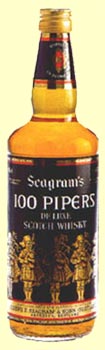
The name '100 Pipers' was taken from the one hundred pipers who proceeded Scotland's legendary hero, Bonnie Prince Charlie, into battle. It is said that the pipers used to entertain the generals relaxing with the bubbly in the dusk after the day’s battle. The producers assure you that after a couple of drinks, you can hear the distant strains of the pipers’ music! This is something I cannot testify, as I have never been able to reach that level of inebriation!

Then we have the ‘Cutty Sark’ whose main office in Glasgow is less than ten miles from the birthplace of the famous River Clyde-built clipper ship of the same name. Interestingly, the word means ‘short underskirt’ and is prominently mentioned in the famous poem ‘Tam o’Shanter’ by Robert Burns.

The glen series of whiskies – Glenlivet, Glenfraclas, Glen Elgin, Glenrothes, … – are mostly named after the valleys where the distilleries are located. Glenfiddich, which comes in the characteristic triangular bottles, is Gaelic for Valley of the Deer and Glenmorangie is believed to be derived from either gleann mor na sith – Valley of tranquillity or gleann mór innse – Valley of Big Meadows.

Laphroaig, Lagavulin, etc are areas in the Isle of Islay. The former is an area of land at the head of Loch Laphroaig on the south coast. The meaning is unknown but a commonly suggested derivation implies the elements ‘lag’ (Gaelic: hollow), ‘breid’ (Norse: broad) and ‘vik’ (Norse: bay), implying an original Gaelic form something like ‘Lag Bhròdhaig’ (the hollow of Broadbay). The name may be related to a placename on the east coast of Islay, ‘Pròaig’, again suggested as meaning broad bay’.

And there are oddities too - Dimple is known by that name everywhere except in the USA where it is called Pinch. There's something special called - what else? 'Something Special'! One of Seagram's most successful retail blends in the 1970's, one does not get to see much of it lately.


My son reminds me of another brand: With that name for a whiskey, even if you are a teetotaller, and when asked, 'What'll you have?' politely decine the offer for a tipple, a drink can be thrust upon you because you said, 'Kuchh nai'! Trust a Sardarji to come up with such a brilliant idea! If you can't believe this, have a look at the label and see the name of the distillery: Five Rivers International Limited. Those who still remember their school geography will know that 'Punjab' means 'Five Rivers'.

One of the first advertisement slogans I recall having seen was ‘Don’t be vague, Say Haig’. And the most striking visual I can recall in an ad was the one where a man is entertaining his boss. It’s very subtle: he pours a large drink for himself, but when it comes to the boss, he is a bit miserly, large enough, but not as large. The dilemma of the man is writ on his face: pour a large and keep the boss happy, but that leaves hi with a depleted stock of the amber liquid!

How can I conclude this piece without referring to the etymology of the word ‘whisky’? Americans spell the word as ‘whiskey’. The word comes from usquebaugh, which English borrowed from Gaelic (Irish uisce beatha and Scottish uisge beatha), meaning ‘water of life’, the same thing as the Latin aqua vītae which had been applied to distilled drinks since early 14th century. Readers are requested not to confuse this with Shivambu, the beverage India’s one-time Prime Minister Morarji Desai advocated as the water of life for its medicinal value.

There’s a sher I cannot resist the temptation to quote, with apologies to those who do not understand Hindi:

Mein peeta nahin…
Mein peeta nahin hun…
Jab bhi mein peeta
Peeta hun whisky
Kabhi uski, kabhi iski.


Tailpiece:
I have taken more out of alcohol than alcohol has taken out of me. -
Winston Churchill

Wednesday, July 07, 2010

MY ROLE MODEL

Part of my childhood was spent in Calicut in Malabar where my father had a middle-level job in the Central Government. He was what is described these days as a Class III (Or, is it Class II?) employee. We’re talking of the 1950’s when the take-home pay was meagre. With more than half a dozen mouths to feed, all he could afford was a two-room block. Ours was one in a row of seven such blocks, each sharing a wall with the neighbour’s.

.

We had one luxury: as it was at one end, it had three sides open; five of the remaining six had only two sides open. This, however, was not an unmixed blessing: the windows opened to a marshy area. In the rainy season, water hyacinths grew and mosquitoes bred there in abundance. It was home to a few water snakes and thousands of frogs which would croak all night.

.

In summer, it would become a marshland. In stark contrast to the sea of green and bluish purple that it was in the monsoon, it would turn a dull brown and grey, as the succulent hyacinths dried up.

.

Electricity was meant only for providing light – no fans! - in the nights. Kerosene oil was in short supply most of the time and cooking gas was unheard of.

.

Firewood was the only fuel even in affluent households. In the villages, they used to collect dried palm-fronds, but town-dwellers had no access to it. The saw mill town of Feroke being close by, saw dust which was available in plenty was the major fuel used. Vendors would visits residential areas come every Sunday to take orders. They would effect delivery during the course of the week – each locality had a specific day. The cart laden with huge jute bags containing saw dust would come to our area every Tuesday with its three-man strong crew – the heftier among them pulling it and the weaker two pushing it from behind. After parking the cart in front of the fourth block, the ‘puller’ would take a breather – he would climb onto the cart, lie down on the bags and take a nap while the ‘pushers’ would deliver the goods, carrying the bags on their back.

.

For obvious reasons, saw dust could only be stored in the open. This posed a grave problem in the rainy season: a lot of the inventory would get washed away. Therefore people would switch to firewood which was more expensive. That is when Gopi would be in great demand.

.

Well-built and muscular, he would push his handcart in the morning to the timber-yard, buy logs in bulk, pull the heavily laden cart back, selling it at retail prices to housewives who would request him to hew it for them. He would do that – for a price, of course – and move on. He had his regulars: those who would patronise him whether it was rainy season or not. Households like ours would entertain him only during the monsoons, but he never used to grudge that.

.

Gopi had a very bad stammer – in fact, I have never seen the person with as bad a speech defect as his. You ask him the price of a cwt of timber and his facial muscles would go into contortions in the strain he underwent to give a response, but not a word would come out for a long time. We kids would watch him open-mouthed as he struggled to get his answer out. In retrospect, I think the fact that we were watching him possibly made him even more nervous. And finally, when you gave up all hope, ‘the word’ would issue out. And he would beam, happy that his endeavour had borne fruit.

.

His was a one-man show – he pulled the log-laden cart alone and hewed the logs himself with none to help him. The muscles in his calf and thighs were firm and well-formed. The way his sinewy limbs moved rhythmically was a treat to the eyes. Our bedroom window provided us a ringside seat to watch the muscles move up and down as he heaved the axe to split the logs in the open space next to our block.

.

You could set your clock every morning when Gopi passed by, pushing the cart. Rain or shine, bare-chested, and clad in a lungi with a towel for a headgear that doubled as a wipe for the sweat, he passed by, pushing the cart every morning.

.

In the evening, you would see him amble along in a new avatar – a fresh well-starched and ironed shirt, sparkling white crisp dhoti, a cigarette dangling from his lips below his moustache like the one Bhagat Singh had. He would spend a couple of hours with his friends and return by dusk.

.

Sunday was the day out for his family. In the evening, he would be accompanied by his wife, with two kids in tow, all smartly turned out. They would spens time in the beach or Mananchira Maidan, or watch a movie or the circus, and return home in time for dinner.

.

For the young boy that I was, Gopi was the paragon of virtues a man ought to possess – a self-reliant man making an honest living by working hard during the weekdays, relaxing with friends in the evenings and enjoying the bliss of family life in weekends. He was very matter-of-fact and would professional in whatever he did. Have I really been able to lead a life that emulated his? I wonder.


Sunday, July 04, 2010

The Two Gardners

There were two Gardners who impressed me when I was young. Both influenced me, but for very different reasons. Both lived long, both had a variety of interests and both had authored dozens of books, though neither could stake claim to much formal education in the subject they are well-known for.

One was Erle Stanley Gardner (July 17, 1889 – March 11, 1970), the American lawyer and author of detective stories. Who has not heard of ‘The Case of the …’ series? For some curious reason, he had several pseudonyms other than the more popular A.A. Fair, some of them being Kyle Corning, Charles M Green, Carleton Kendrake, Charles J Kenny, Les Tillray and Robert Parr. He created many different unforgettable characters like the ingenious Lester Leith, a ‘gentleman thief’, Ken Corning, a crusading lawyer and Perry Mason, the lawyer and crime-solver who featured in more than eighty novels he wrote.

Gardner’s formal study of law school lasted approximately one month, for he was suspended from school when his interest in boxing became a distraction. Later he became a self-taught attorney and passed the state bar exam in 1911. Innovative and restless in his nature, Gardner was bored by the routine of legal practice, the only part of which he enjoyed was trial work and the development of trial strategy. His other interests were travel, history, and forensic science.

This Gardner made many of my long and tedious train journeys short and interesting; they had more entertainment value that edification. His namesake, Martin Gardner (October 21, 1914 – May 22, 2010), was of the cerebral kind. I first I came across him in the puzzle column of the Scientific American in the United States Information Service Library (USIS), Trivandrum which was closed down, thanks to the communists here and whose immaculate white building on the Main Road was razed down, thanks to the rapacious real estate lobby.

Later, my colleague and friend Dr C V Ram Mohan gifted me a book of puzzles, mostly mathematical ones, authored by Martin Gardner. Apart from teasing brains with math puzzles for a quarter century, Gardner wrote books on topics as diverse as magic and philosophy. He wrote fiction, poetry, literary and film criticism. He was so prolific and wide-ranging in his interests that critics speculated that there just had to be more than one of him! Gardner used to say that his life was not all that interesting, really. ‘It’s lived mainly inside my brain,’ he said.

The owner of a questioning mind, his was a leading voice in refuting pseudoscientific theories, from ESP to flying saucers. Who, but Gardner, could have taken his hero Lewis Carroll to task in ‘Annotated Alice’ (1960) for writing of a ‘golden afternoon’ in the first line of ‘Alice’s Adventures in Wonderland’, for, he had found that the day, July 4, 1862, was, in fact, ‘cool and rather wet’?

His was a clarifying intelligence: he said his talent was asking good questions and transmitting the answers clearly and crisply. His puzzles were often mathematical. What is special about the number 8,549,176,320? As Gardner explained, the number is the ten natural integers arranged in English alphabetical order. Though his mathematical writings intrigued a generation of mathematicians, he had not studied the subject formally beyond school.

His fans included names as celebrated and diverse ass W H Auden (Poet), Douglas Hofstadter (Cognitive scientist), Vladimir Nabokov (Of the Lolita fame), Arthur C Clarke (The Sci-Fi man), Jacob Bronowski (Polymath), Stephen Jay Gould (Evolutionary biologist) and Carl Sagan (Astronomer). Nabokov referred to him in his novel ‘Ada’ as ‘an invented philosopher’. An asteroid is named after Gardner.

‘Martin Gardner is one of the great intellects produced in this country in the 20th century,’ said the Douglas Hofstadter whose seminal work ‘Metamagical Themas’ (Anagram of Mathematical Games) has left me astounded. Incidentally, he was Gardner’s successor at the Scientific American in said Gardner achieved elegant results by drawing on fields from logic to the philosophy of science to literature. He conveyed ‘the magical quality of mathematics,’ Dr. Hofstadter said.

Gardner rejected speculative metaphysics because it could not be proved logically or empirically. He debunked pseudoscience and said he found no reason to believe in anything religious except a human desire to avoid ‘deep-seated despair’; so, he said, he believed in God. Stephen Jay Gould described Gardner as ‘the single brightest beacon defending rationality and good science against the mysticism and anti-intellectualism that surround us’.

Coming as it does from someone who had done the puzzle column in the Scientific American for twentyfive years from 1956, Gardner was self-effacingly transparent when he said, ‘The number of puzzles I’ve invented you can count on your fingers.’ Gardner admitted that to keep just ahead of his monthly deadline, he used to rush out to secondhand bookstores scouring for books about math puzzles, an approach he used for years. Not for nothing that Adam Gopnik wrote of him in The New York Times Book Review in 1999 that Gardner had ‘an old-fashioned, almost 19th century kind of mind – self-educated, opinionated, cranky and utterly unafraid of embarrassment.’


For all his success in refuting those who take advantage of people’s gullibility, he sometimes could not help having fun with it himself. In one Scientific American column, he wrote that dwelling in pyramids could increase everything from intelligence to sexual prowess. Perhaps that was what he meant when he said, ‘I just play all the time and am fortunate enough to get paid for it.’ I’m sure not many of us enjoy that privilege.

Saturday, June 26, 2010

PUZZLING UNISEX NAMES

I am no film buff, but I remember the Raj Kapoor film ‘Bobby’ very well. This 1973 Bollywood film was widely popular. Dimple Kapadia debuted in the film playing the daughter of a poor fisherman Jack Braganza (played by Prem Nath). It gave the first leading role to Rishi Kapoor as the son of a rich businessman Mr Nath (played by Pran). Numerous movies in the following years in several languages were inspired by this plot.

It is not for these reasons or because it was a trend-setter which introduced the genre of teenage romance with a rich-vs-poor clash as a backdrop that I remember the movie. There are two very different reasons.

The first of them can be called a story within a story. It needs some elaboration. I saw the movie one Sunday in the Globe Cinema in Calcutta. There was this scene in the film where the mother is busy in the kitchen preparing a meal for the family. She is cutting a big fish when the distraught daughter comes to the kitchen and breaks the news to her mother – that she is expecting. The mother is shocked and turns hysterical; she drops the knife and the fish, as the whole world comes crumbling down.

It is an emotion-charged moment and the audience is tense. From the front row, someone shouts, ‘O maacchh-ta kothey gaye-lo?’ (Loosely translated as: What happened to the fish?) As a Mallu who likes his fish, I could commiserate with the piscophagic Bong brother.

The second is that all along, I had thought only boys were named ‘Bobby’ and this movie proved me wrong. Dimple, the young heroine was ‘Bobby’ here.

In later years, during my stint in Punjab, I had an overdose of unisex names. (Not that Kerala does not have its share: Money, Baby, Joy, Shine, Jolly etc being some.) Amrinder, Parminder and Shivinder could be a Kaur or a Singh.

Thereby hangs a puzzle:


My wife used to teach in a co-ed school in Patiala. She was the class teacher in Class X C of the school. Gurinder and Bhupinder were the Monitor and the Assistant Monitor of the class.


On the first day, she asked Gurinder: How many of you are girls?

Gurinder replied: 5/14 of my classmates are girls.


She repeated the question to Bhupinder.

Bhupinder replied: 3/8 of my classmates are girls.


What are the genders of Gurinder and Bhupinder?


Some may think this is a trick question and others may even dismiss this as having nothing do with mathematics! But if you apply yourself carefully, you can see that if both were girls, their answers would have been identical. Similarly, if both were boys, their answers would have been identical.


The fact that the answers that Gurinder and Bhupinder different makes it clear that they are of different genders.

Compare 5/14 and 3/8. We see that 5/14 = 20/56 and 3/8 = 21/56. Obviously, Gurinder is a girl and Bhupinder is a boy.


If it is not ‘obvious’, and further explanation were needed, it can be inferred that the person who says that the lesser fraction, namely, 20/56 (and not 21/56) of classmates are girls is a girl herself [and the person who says 21/56 (and not 20/56) of classmates are girls is a boy]. Therefore Gurinder is a girl and Bhupinder is a boy.


In case a mathematical solution is required, let the number of boys and girls be b and g respectively.


If Gurinder is a boy and Bhupinder is a girl, Gurinder’s statement means ‘g/(b + g - 1) = 5/14’ and Bhupinder’s statement means ‘(g – 1)/(b + g - 1) = 3/8.Subtracting, 1/(b + g - 1) = 5/14 – 3/8 = ( - ) 1/56 which is not possible. Therefore Gurinder is a girl and and Bhupinder is a boy.


Further research: As Gurinder is a girl and and Bhupinder is a boy, Gurinder’s statement means ‘(g – 1)/(b + g - 1) = 5/14’ and Bhupinder’s statement means ‘g/(b + g - 1) = 3/8.Subtracting, 1/(b + g - 1) = 3/8 – 5/14 = 1/56. This means (b + g) = 57. Substituting in g/(b + g) = 3/8, g/56 = 3/8 or g = 21. Therefore b = 36.


Sanity Check: What Gurinder, a girl, says means !21 - 1)/(57 - 1) = 5/14. What Bhupinder, a boy, says means 21/(57 - 1) = 3/8.


Tuesday, June 08, 2010

Books, Anyone?


‘The house is getting cluttered,’ everybody started complaining. (After our kids left home for studies circa 2003 and then started working, we’re empty-nesters: it is just the two of us at home. Now you know who’s the everybody doing the complaining!)

Jokes apart, my brother-in-law who came home on a visit called my wife aside and admonished her, ‘What have you done to this house? It was such a nice little place when I came last! Look at this now. Worse than a railway platform!’

My older son who came on a short holiday announced, ‘This house needs to be de-cluttered.’ The next time I come, it’ll be on a month’s leave and I’ll take up the task.’

There a lot of bric-a-brac collected from all sorts of places over four decades – marble statuettes from Bhedaghat near Jabalpur to brassware from Moradabad, lacquered toys from Sankhed in Gujarat, phulkari from Sunam in Punjab, boomerang from Australia and the niniature of the ‘Mannekin Pis (The Pissing Boy)’ from Brussels, what have you.

The major chunk of what constitutes the ‘clutter’ is books. I was a bibliophile since my student-days and after I started earning, I have been buying books. My wife has her own collection of books before our marriage. Our personal collections got married in January 1976 along with us. As our family grew, so did the books. Only, it was not pro rata. With the addition of two kids, the size of the only doubled, but the size of the library grew ten-fold, if not more.

And we have been subscribing to excellent magazines. Apart from the ubiquitous Readers’ Digest and the National Goegraphic, we had the Economic and Political Weekly, The American Review, Seminar and the like.

How do you de-clutter? We asked the school nearby if they could accept the books. The Principal shooed us away thinking we were selling books. When we clarified that we wanted to donate and not sell the books, she suspected that we were planting books that might corrupt the mind of the youth – spreading messages of fundamentalism or violence against one sect or another!

We tried another tack: why not approach government-run libraries? The State Central Library flatly refused: we have no space for any more books. In fact, we are scared that the books from the British Library which closed down a couple of years back will come to us. (Yes, the librarian used the word ‘scared’!)

The University Library said: Please give us a list of the books (In quintuplicate, if you please!) so that we can see if we do not have any of them. We’ll take only such books as we do not have on our shelves.

He sounded as if Article 43 Clause (12) Subclause (k) of the Service Regulations of the Librarians of the University of Kerala stated that the retirement benefits of a librarian are liable to be forefeited if multiple copies of the same book are found in the stock.

A friend told us of a school being run by a former bureaucrat for the underprivileged classes. She was delighted to hear about our offer. The books would be a welcome addition to their library.

So a few dozen cartons of books will soon be moving out of our house to the school library. I feel as if a part of me were being removed but I am happy in the thought that instead of gathering dust, the books would hopefully would be read by scores of boys and girls.

Sunday, June 06, 2010

On Growing Old

Thanks to the social networking sites like Orkut, Facebook and the like which ask for your birthday and remind all your ‘friends’ a couple of weeks ahead of your birthday that your big day is coming up, the other day I was felicitated on my birthday over a hundred times by ‘scraps’, on my ‘wall’, everywhere. Add to that my credit card company, my bank, my travel agent, my share broker, my mobile service provider, my broadband service provider, Jet Airways and the Oberoi group of Hotels whom I used to patronize once upon a time; SMS and e-mail messages from all of them too greeted me on the occasion.

When I was a child, we did not ‘celebrate’ birthdays in our home. A mandatory visit in the dawn to the temple and a ‘paayasam’ for lunch, that was about it. And when you grew up and went away, even those tokens faded away. Many birthdays passed unnoticed, for there was nobody to remind you that the day was a special one.

I have noticed that people who have crossed fifty do not like to celebrate birthdays. With advancing age, it appears that man’s cheery disposition gives way and anxiety becomes his constant companion. It is not for nothing that the philosophy that our forefathers handed down to us reminds us constantly of the impermanence and the transient nature of Life. The inexorable flow of time brings about changes – lack of joy (which is not sorrow) and numbness (which is not despair) shroud the mind. We see that there is good reason why the wise sages christened the God of Death as ‘Kaal’ which happens to be a synonym for Time.

We know that Time, in its quest, robs us of several things. The very thought that it snatches away your precious possessions, as teenage makes way for youth, youth for middle age and middle age for old age, is indeed unnerving. The past always looks more appealing than the present because looks, health, elegance and smartness wane with time. In a sense, we seem to be running back from the harsh reality that ‘Today’ is to the magnificent dream that ‘Yesterday’ was.

This perhaps explains why the photographs people tender for getting ID cards etc are always those taken when they were younger. What is the emotion that you feel when you see Waheeda Rahman or Meena Kumari on Chitrahaar and reflect that she is on the wrong side of eighty now? Anxiety, sympathy or relief?

Middle-aged couples who take a long sigh after taking a look at their wedding photographs undergo very complex emotions which extend beyond worries about the charm they exuded in the past. Distress arising from fear of death and helplessness of the defenceless create a chiaroscuro in their minds.

Even as we accept that the most exquisitely chiselled body, in time, would change beyond recognition and then disappear, we nurse the hope, irrational though it is, that we can halt the inexorable flow of Time. We have the skill to fabricate myths that deceive ourselves – like false teeth, wigs and stuff. The mainstay of the cosmetic industry is man’s propensity for self-delusion – the belief that hair dye, skin creams and facepacks, botox and plastic surgery can arrest aging.

But then, why don’t we realize that Time is smarter than all of us put together? We cannot beat Time; our efforts are easily trivialized, nay, neutralized by it. You may dye your hair, but the wrinkles on your skin will show up. You try plastic surgery, and arthritis will get you. You wear contacts, Time will give you a weak ear. Time has a way of getting at you, whatever you do.

But then, Time has a sense of justice too. Even as it robs you of a precious asset, it gives you another. As it snatches youth, you gain in experience. As you lose your parents, you are blessed with grandchildren; as you forefeit mobility, you gain the ability to introspect.

How futile it is to sigh, leafing through the album of youth or to worry about the physical infirmities instead of embracing Life, and welcoming each day confidently, gratefully, without setting conditions!

Tuesday, June 01, 2010

Internet Cafe


Those were the early days of computerization in banks. The Reserve Bank of India had drawn up an ambitious scheme of computerization that would ultimately result in networking of branches, ATMs, real time transactions and settlements etc. They were breathing down the necks of Chairmen and Managing Directors of banks who were breathing down the necks of Executive Directors who were breathing down the necks of …

There was a direction from the Reserve Bank of India that the Board of Directors of banks should oversee the implementation of computerization. Towards this end, banks were asked to submit a monthly progress report containing details like the number of computers installed, branches computerized, ATMs installed, the extent of computerization in percentage terms and the like.

One of the directors of the bank I was working for in those days was a youngish management expert. He had had exposure abroad and knew a thing or two about computerization. Having worked for a couple of years in another bank before going abroad for higher studies, he understood banking as well. Naturally, he used to take keen interest when the item on computerization came up for discussion in the Board.

The initial resistance of employees to computers had not yet been overcome. Even those who were interested in learning how to use a PC were afraid of using them for fear of damaging them. Lectures on computerization had not made the desired impact. In short, the progress was rather slow.

It was not just the employees, most of those at the top echelons too were luddites and totally ignorant of how technology worked, how it could be harnessed and how it could make the office a better place to come to and work in, with more time for quality and reactivity, as it would throw drudgery out of the seventh floor window.

The Board, charged with the task of monitoring the progress, was patently exercised over the tardy pace. In one of the meetings of the Board of Directors, a director suggested that there should be a brainstorming session on the steps that could be taken to remove the fear factor. Several ideas were mooted.

I was an invitee to the meeting in my capacity as a General Manager of the bank. Though not in charge of computerization, I shared the experience in one of the departments under my control. It was headed by an enterprising Chief Manager who too was troubled over the lack of enthusiasm on the part of his staff in embracing technology.

He loaded a few simple games like hangman, bricks and word fun in the computer which everybody had access to but few were handling. During lunch hour, he played computer games, sitting alone. Some who passed by stopped to watch. Soon, there were more viewers and interest spread. Many of the spectators turned players.

Employees were allowed to play computer games before and after office hours and during lunch hour. Initially, there were more viewers than players but soon enough, it caught on. They found that the PC was, after all, not a dangerous animal! Then they started using it for office work. In due course, they discovered how PCs helped eradicate the drudgery of routine work. In no time, most of them acquired basic skills like word processing, spreadsheet etc. and had learnt how to surf the net and dig out information.

This appealed to the young director. Making PCs freely available to the employees would encourage them to use it. This, he hoped, would familiarize employees with the machine as it happened in the case described by me. He suggested that in any unit like the Head Office or the Zonal Offices with a large number of employees, the bank could set up an internet café with free access to the employees.

Upon which the CEO said, ‘We have well- appointed and hygienic canteens at the Head Office and the Zonal Offices which serve excellent coffee and tea to the employees both in the forenoon and the afternoon, that too at subsidized rates, using the Staff Welfare Fund.’

Saturday, May 22, 2010

KAPREKAR'S SOLITAIRE

We have all heard of Srinivasa Ramanujam, the great Indian mathematician, but if I mention D R Kaprekar, you’ll ask me, Kaprekar who?

Dattaraya Ramchandra Kaprekar was a schoolteacher in Nashik (Maharashtra). This 1905-born received his secondary school education in Thane and studied at Fergusson College in Pune. In 1927, he won the Wrangler R. P. Paranjpe Mathematical Prize for an original piece of work in mathematics. He had no formal postgraduate training and working alone, discovered several interesting properties of numbers.

Initially, his ideas were not taken seriously by Indian mathematicians. International fame arrived late in 1975 when Martin Gardner wrote about Kaprekar in his column Mathematical Games for The Scientific American. Today his name is well-known and many other mathematicians have pursued the study of the properties he discovered.

Though he is credited with the discovery of Devlali Numbers, Harshad Numbers and Demlo Numbers, the most famous of his discoveries is the Kaprekar Constant.

Most numbers can be generated by adding another number and its digits. For instance, take 23. It is 16 + 1 + 6. Take 70. It is 62 + 6 + 2. Now try the same thing with 20. Now matter what you do, it is impossible to generate 20 in this manner. Thus 20 is a Devlali Number. The first 20 Devlali Numbers are 1, 3, 5, 7, 9, 20, 31, 42, 53, 64, 75, 86, 97, 108, 110, 121, 132, 143, 154, 165, 176, 187, 198, 209 and 211.

A Harshad number is one divisible by the sum of its digits. Take 23. As it is not divisible by 2 + 3 = 5, it is a non-Harshad Number. However, 70 is, as it can be divided by 7 + 0 = 7. The numbers 1 to 9 are all obviously Harshad Numbers. The next 25 Harshad numbers are 10, 12, 18, 20, 21, 24, 27, 30, 36, 40, 42, 45, 48, 50, 54, 60, 63, 70, 72, 80, 81, 84, 90, 100 and 102.

I found the Demlo Numbers too complicated for me but Kaprekar Constant, the jewel on the Kaprekar crown, is fascinating. It is a really mysterious number, though at first glance, it might not seem so obvious.

Take any four-digit number with at least one digit different from the rest.(That is, not 1111, 2222, ...). Write down the largest and the smallest numbers that can be formed from its digits. Subtract the smaller number from the larger to get a new number. Repeat the operation for the result obtained. If you carry one the process, you will find that it ends in a number that repeats itself. Let us call this repeating number the kernel of this operation for that number.

For instance, let's take 2010, the current year. The largest number we can make with these digits is 2100, and the smallest is 0012 or 12. The process is: 2100 – 12 = 2088 >> 8820 – 288 = 8532 >> 8532 – 2358 = 6174 >> 7641 – 1467 = 6174 >> 7641 – 1467 = 6174 >> … We find that the kernel of 2010 is 6174 and have reached the kernel in three steps.

Okay, you reach a kernel, so what?

Now take 2005. The operation yields 5200 – 0025 = 5175 >> 7551 – 1557 = 5994 >> 9954 – 4599 = 5355 >> 5553 – 3555 = 1998 >> 9981 – 1899 = 8082 >> 8820 – 0288 = 8532 >> 8532 – 2358 = 6174 >> 7641 – 1467 = 6174 >> 7641 – 1467 = 6174 >> …

This time it has taken a few more steps to reach the kernel from 2005, but are you surprised that the kernel is the same, namely 6174? Sheer coincidence, you and I would have thought.

Kaprekar thought differently. He discovered that this simple operation led to the surprising result that the kernel cannot but be 6174! Every four digit number where the digits aren't all equal reaches 6174 under Kaprekar's process. It's marvellous, isn't it? Kaprekar's operation is so simple but uncovers such an interesting result.

Is this as special as 6174 gets? Well, not only is 6174 the only kernel for the operation, it also has one more surprise up its sleeve.

Let's try again, starting with a different number, say 1789. Here we go: 9871 – 1789 = 8082 >> 8820 – 0288 = 8532 >> 8532 – 2358 = 6174.

When we started with 2010 and 1789, the process took us to 6174 in three steps, but 2005 took seven steps. In fact, you reach 6174 for all four-digit numbers that don't have all the digits the same and in at most seven steps.

For three-digit numbers, the same phenomenon occurs. Application of Kaprekar's operation to the three digit number 753 gives the following: 753 – 357 = 396 >> 963 – 369 = 594 >> 954 – 459 = 495 >> 954 – 459 = 495 >> 954 – 459 = 495 >> … The number 495 is the unique kernel for the operation on three digit numbers, and all three digit numbers reach 495 using the operation.

How about other numbers? Let try it out for a two digit number, say 28. We have 82 – 28 = 54 >> 54 – 45 = 9 >> 90 – 09 = 81 >> 81 – 18 = 63 >> 63 – 36 = 27 >> 72 – 27 = 45 >> 54 – 45 = 9 >> 90 – 09 = 81 >> 81 – 18 = 63 >> 63 – 36 = 27 >> 72 – 27 = 45 >> 54 – 45 = 9 >> … It doesn't take long to check that all two digit numbers will reach the loop 9 → 81 → 63 → 27 → 45 → 9. Not quite as impressive as three and four digit numbers, which have unique kernels.

There is no kernel for Kaprekar's operation on five digit numbers. But all five digit numbers do reach one of the following three loops:

71973 → 83952 → 74943 → 62964 → 71973
75933 → 63954 → 61974 → 82962 → 75933
59994 → 53955 → 59994

It will certainly take a lot of time to check what happens for six or more digits, and this work becomes extremely dull! I’d rather play Solitaire than meddle with numbers like Kaprekar did!

Thursday, May 20, 2010

FELLOW-FEELING


I was looking for a Khalil Gibran quote. I knew it was there in one of the paperbacks I have, but did not recall which one. I went to my study looking for it.

The books were in a total disarray. Giving up the search for the quote for the time being, I decided to rearrange them on the shelves in some order so that one would not have to launch a search the next time.

As I dusted the books one by one and put them in their assigned places, a book caught my attention. It was a Malayalam paperback: ‘Vasco da Gaamayum, Charitrattile Kaanappuranngalum’ (Vasco da Gama and the Unseen Pages of History) by Sathyan Edakkad. I am not much of a history buff and did not recall having purchased it. My wife Bhawani is interested in history, but it was very unlikely that she would have purchased a book written in Malayalam.

It appeared to be a new book, not read by either of us. How did it reach here? I wondered. Bhawani refreshed my memory, Santanu had dropped it in your bag at the Fort in Kannur.

***

My Bengali friend Santanu and his wife Arundhati were on a ten-day visit to Kerala. Santanu was a colleague and we have known each other for over three decades. Santanu had taken an early severance and turned to writing and translation and had published a few books, which, I guess, were a modest success.

Though they had lived for a while in Kerala as Santanu was employed here, they had not had the chance to ‘experience’ Kerala. We decided to drive down from Trivandrum (in the southern tip) where we lived, to my hometown Kannur (500+ kms to the north) with a few pitstops. They would stay with us in Trivandrum for a couple of days, travel the longish stretch with us over three days and stay with us and my mother in Kannur for a few days.

While in Kannur, we went round seeing places of interest in and around Kannur like the Pazhassi Project, the Arackal Museum, the Muzhappilangad beach (Arundhati quips that the name is as hard as the beach. The beach, in case you did not know, is so hard that you can drive cars on the sand at 60 kmph!) and the like.

One of our destinations was the recently beautified premises the St Angelo’s Fort on Kannur Beach. A seashore fort, it's a photographer's delight, etched against the blue sky. The spirit of the past still echoes within the walls of this fort and continues to enthrall its visitors.

As soon as we crossed the moat (apparently built to protect the fort from aggressors) and entered the premises made up of massive laterite stones built on a rocky promontory, a young policeman accosted us. His epaulet had a brass plaque which read TOURIST POLICE.

The sergeant was very friendly. He asked us if it was the first time we were visiting the fort. He told us the chequered history of the fort in brief. As he walked us through the endless corridors of the fort, up the turret and through the manicured lawns, the spool unreeled: how it was built in 1505 by Dom Francisco de Almeida, the first Portuguese Viceroy of India and how it changed hands many times over..

Almeida had refused to accept the appointment of Afonso de Albuquerque in 1509 as the new Portuguese governor. Desperate to continue as the boss of what he considered ‘the gains of his hard work’; he went to war with Albuquerque and imprisoned him in this fortress. After three months of confinement, Albuquerque went on to become the governor when the mutiny was suppressed with the arrival of a larger fleet from Portugal in October 1509.

In 1663, the fort was captured by the Dutch from the Portuguese. They sold it to Ali Raja (of the Arackal Dynasty) of Kannur. After the ascendancy of the British in Malabar, in 1790, the British seized control of the fort, renovated and strengthened it and transformed into their most important military station in Malabar.

We were surprised and impressed by the cop’s knowledge. We could not resist the temptation to ask him how he learnt all this. He said he was shocked at the ignorance surrounding the earliest European fort in India. When he was posted there, he said, the impression among the locals was that it was Tipu Sultan who had constructed the fort! As a tourist cop, Sathyan had to face a barrage of questions about the fort from visitors to which he had no answers. That made him brush up his history. He spent a lot of time reading up history and became a walking encyclopedia on the fort and its legends.

As we complimented him on his interest and knowledge and thanked him and wished him well, he smiled shyly and said, ‘I have written a book exploding the myth of Vasco da Gama’s landing at Kappad in 1498.’ I leafed through the copy he showed me. The book, written in Malayalam, challenged a basic historical assumption. ‘Two of Vasco da Gama’s sailors landed at Kappad,’ Sathyan says in the book, ‘but Gama stepped ashore 12 km north, at a place called Panthalayini Kollam.’

Santanu asked him, ‘How much does this book cost?’ Sathyan named the price. Santanu, who cannot read Malayalam, bought a copy. As I wondered why, he said, ‘This is the least that a struggling author can do to encourage another.’